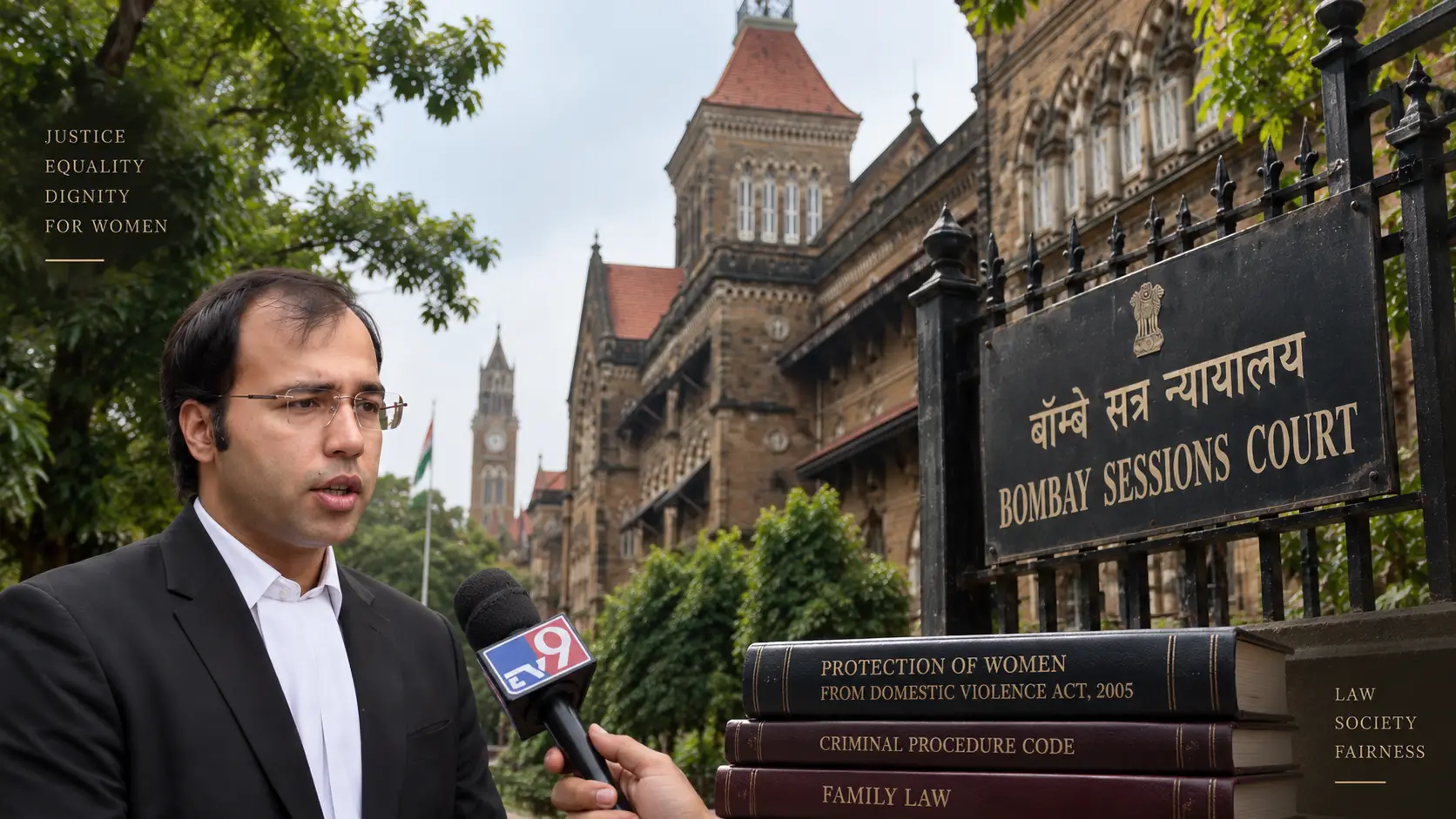

The Court of Sessions at Mumbai, in exercise of its appellate powers under Section 29 of the Domestic Violence Act of 2005, enhanced the quantum of interim maintenance granted to a Mumbai woman from Rs. 25,000/- to Rs. 35,000/- per month. Advocate Aditya Pratap had represented the aggrieved wife who had challenged the quantum of maintenance granted to her by the Kurla Magistrate Court as being insufficient to cater to her monthly expenses and standard of living.
Represent his client who had filed an Appeal under Section 29 of the Domestic Violence Act, Advocate Aditya Pratap had argued that the Court of the Metropolitan Magistrate in Kurla, while awarding interim maintenance of Rs. 25,000/- per month, had not taken due account of the severity of the wife and children’s condition. He accordingly prayed for enhancement of the quantum of interim maintenance granted by the Magistrate Court.
Passing its final judgment, the Mumbai Sessions Court partly allowed the appeal filed by the wife. It enhanced the amount of monthly interim maintenance from Rs. 25,000/- to Rs. 35,000/- per month. It further held that the enhanced amount was to be calculated and paid right from the date on which the application/complaint for domestic violence was filed before the Magistrate Court in Kurla, Mumbai.
Factual Matrix of the Case:
Advocate Aditya Pratap commenced his arguments in the case by presenting the factual matrix of the matter. He submitted that the appellant wife had married the respondent husband in 1995. There were two children from the marriage, a son and daughter respectively. Shortly after the marriage, the husband began ill-treating his wife, subjecting her to various forms of abuse as outlined in Section 3 of the Domestic Violence Act of 2005.
Advocate Pratap further argued that the husband had sold off his ancestral properties at Bandra and Chembur and received several crores of rupees in consideration for the same. These amounts were pocketed by him and siphoned off. He further submitted that the respondent husband was an affluent businessman active in the shipping industry.
On account of the lavish finances of the husband and mounting monthly expenses of the wife and her children, the amount of Rs. 25,000/- awarded by the Magistrate Court was inadequate. Hence a fit case was established for enhancement of the amount by the Mumbai Sessions Court in exercise of its appellate powers under Section 29 of the Protection of Women from Domestic Violence Act, 2005.
Decision to Proceed Ex Parte against the Husband
Prior to commencement of the final hearing, Advocate Aditya Pratap had pointed out that despite service of notice of filing of the Appeal, the respondent husband had failed to appear or present himself before the Sessions Court. Further he did not engage any lawyer to appear or argue on his behalf.
Advocate Pratap further pointed out that pursuant to directions passed by the Sessions Court a public notice regarding filing of the Section 29 Appeal had also been published in the English Newspaper Free Press Journal and the Marathi Newspaper Navshakti. Despite the publication of the public notice, the respondent husband failed to appear or present himself before the court. Hence a fit case was made out for deciding the appeal ex parte in the husband’s absence.
The Court noted the husband’s absence and the affidavit of service filed by the appellant wife. It accordingly directed that the Appeal be heard and decide ex parte in the husband’s absence.
Grounds for Enhancing the Quantum of Monthly Interim Maintenance:
Advancing arguments on behalf of his client, Advocate Aditya Pratap submitted that the aggrieved wife had opted to file an Appeal under Section 29 of the Domestic Violence Act of 2005 before the Mumbai Sessions Court. He submitted that the amount awarded by the Magistrate Court was inadequate. As a consequence, the applicant wife was not in a position to maintain either herself or her children.
Advocate Pratap further submitted that in the proceedings before the Kurla Magistrate Court the husband had not denied the existence of a matrimonial relation between him and the appellant wife. He further pointed out that the husband had also admitted the paternity of the two children in his submissions before the Magistrate Court.
Reliance placed on Judicial Precedents and Case Law:
Advancing his arguments pleading for enhancement of maintenance, Advocate Aditya Pratap relied upon the judgment of the Hon’ble Madras High Court in the case of P.N. Elumalai vs. E. Soundaravalli, wherein the High Court had ordered enhancement of the amount of interim maintenance payable by the husband to the wife.
Continuing his arguments, Advocate Pratap referred to the judgment of the Delhi High Court in the case of Khem Chand vs. Bhagwati and Others wherein the High Court had found the husband to have indulged in concealing and withholding information regarding his income from the court. The High Court observed that the Magistrate, in the face of concealment of information and absence of proof, had adopted the correct approach of assuming the income notionally on the basis of minimum wages. Accordingly the Magistrate correctly passed the order of interim maintenance based on the same and his approach could not be faulted with.
Finally Advocate Aditya Pratap also relied upon another ruling of the Hon’ble Delhi High Court passed in the case of Jaiveer Singh vs. Sunita Chaudhary wherein the Court had dismissed the revision application filed by the husband challenging the enhancement of interim maintenance. The Delhi High Court held that the husband, being an Assistant Sub Inspector of Police, was earning well enough to pay Rs. 17,000/- per month to his wife. The High Court had further observed that the husband had failed to place any material on record which would establish his wife’s ability to support herself. Accordingly it proceeded to uphold the enhanced maintenance and dismissed the husband’s revision petition.
Reasoning and Findings of the Court:
Having heard the arguments advanced by the appellant wife through her lawyer Aditya Pratap, the Sessions Court noted that the husband had not placed on record any proof to show that the former was earning any income. The Court further noted that from the documentary evidence adduced by the wife, it was clear that the respondent husband had sold the properties in Bandra and Chembur that had constituted the matrimonial home. The Court further noted that the appellant wife was a senior citizen, aged about 61 years. It recognised her acute need for nutritious food, medical aid and other necessary expenses. The court further observed that the monthly amount of Rs. 25,000/- directed by the Kurla Magistrate Court appeared to be somewhat less considering the huge prices of daily needs.
The Court further observed that the respondent husband was a businessman running a shipping agency. It further noted the husband’s admission before the Kurla Magistrate Court that his business operations were ongoing. Therefore the Court concluded that the respondent husband was capable of paying an enhanced amount of monthly maintenance to his wife.
Final Judgment and Directions of the Sessions Court in the DV Appeal:
Having framed the issues and presented its reasoning and findings thereon, the Court of Sessions at Greater Mumbai partly allowed the appeal and directed the respondent husband to pay an enhanced interim maintenance amounting to Rs. 35,000/- (Rupees Thirty Five Thousand only) per month to the appellant wife. This amount was held to be payable right from the date of filing of the original domestic violence application before the Kurla Magistrate Court. It directed the respondent husband to pay litigation costs of Rs. 10,000/- (Rupees Ten Thousand Only) to the appellant wife.
Conclusion:
According to Advocate Aditya Pratap, the Sessions Court correctly invoked and exercised its appellate powers under Section 29 of the Domestic Violence Act to enhance the monthly interim maintenance amount from Rs. 25,000/- to Rs. 35,000/- per month. The Sessions Court correctly observed that the original interim maintenance of Rs. 25,000/- per month was inadequate considering the growing prices of daily needs. Further the Sessions Count demonstrated its attention to detail by zeroing in on the admissions made by the husband regarding the continuing operations of his shipping business.
Finally, according to Advocate Aditya Pratap, the Sessions Court was legally correct in deciding to proceed with the case ex parte in the husband’s absence. Despite the fact that the original notices sent out at the time of the appeal’s filing had returned unserved, it permitted the appellant wife to publish public notice by way of advertisement in English and vernacular newspapers. This, in the view of the court, amounted to sufficient notice of service and hence, the husband’s continued absence post that stage could not be used to hold up the matter and delay the delivery of justice.