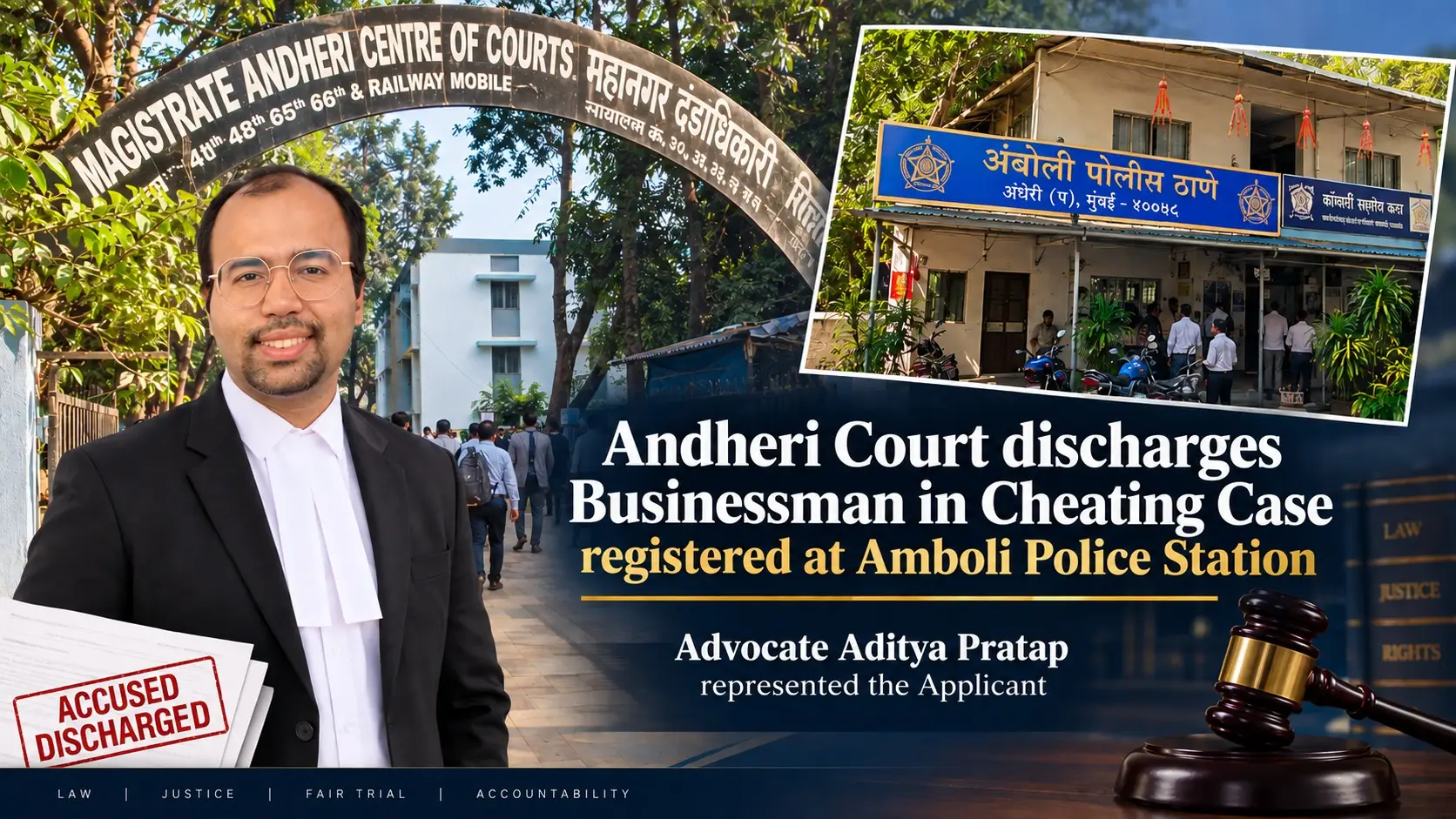

The Court of the Metropolitan Magistrate, 44th Court at Andheri discharged a businessman in a cheating case registered at Amboli Police Station, Mumbai. Advocate Aditya Pratap represented the applicant businessman seeking discharge under Section 239 of the Code of Criminal Procedure, 1973.
Advocate Aditya Pratap had pleaded for his client, the discharge applicant, to be discharged on the ground that the charge sheet filed by the police did not establish any offence of cheating or criminal breach of trust. There was no entrustment of any money or property with the discharge applicant, who happened to be a former employee of the complainant company and an independent businessman in his own right.
Accepting Advocate Pratap’s arguments on behalf of his client, the Magistrate held that a perusal of the entire police charge-sheet revealed the allegations against the accused applicant to be groundless. It was essentially a civil case that was improperly converted into a criminal case. The Magistrate accordingly proceeded to discharge the applicant businessman under Section 239 of the Code and acquit him in the case.
Factual Background of the Dispute:
Appearing for the businessman, who was an accused in the case seeking discharge, Advocate Aditya Pratap submitted that his client was formerly an employee for an Indian nutraceuticals company. During the course of his employment, he was tasked with visiting Russia and CIS (Commonwealth of Independent States) countries in search of business opportunities and exploring new markets for the company’s products.
Accordingly, the applicant contacted a local Russian company which would take up the task of obtaining approvals and thereupon marketing the company’s nutraceutical products. An agreement was signed in 2016 for a total sum of USD 59,000/- for registration and marketing of six products. Out of the said sum, a total ofUSD 39,663/- was wired to the Russian company in two installments to get the products registered.
Thereupon the applicant resigned his employment with the Indian nutraceutical company and proceeded to establish his own business venture. However, out of respect and gratitude for his former employer, he agreed to oversee the registration and approval process to its logical conclusion.
The Products fail to clear Quality Tests – Regulatory Clearance not granted:
Advocate Aditya Pratap further submitted that pursuant to signing of the product registration agreement, the Indian nutraceutical manufacturer dispatched samples of its products to Russia and the CIS countries. The Russian business partner, with whom the product registration agreement was signed, submitted the products for documentary evaluation and clinical testing. There was extensive written correspondence between the Russian and Indian parties as the products cleared the stage of document scrutiny and were accordingly submitted for clinical testing.
During the clinical testing phase however, the nutraceutical products of the Indian company were found to be defective and below the standards prescribed by Russia and the CIS countries. As a consequence, the products of the Indian nutraceutical company failed to clear the tests and hence, their application for registration in Russia and the CIS countries was rejected.
Disputes begin – Indian Nutraceutical Company accuses its former Employee and Russian Business Partner of Cheating:
Rather than accept the fact that its products failed to meet the prescribed standards set by Russian and the CIS countries, the Indian nutraceutical company began to accuse its former employee turned businessman and the Russian company of cheating. It began to falsely accuse the businessman of having pocketed the funds advanced by it under the product registration agreement.
This was a false accusation considering the fact that the funds had directly been transferred by the Indian nutraceutical company to its Russian counterpart. Not a single rupee was ever paid into the account of its former employee-turned-businessman. Further the funds transferred had been paid by the Russian company towards the expenses associated with the scrutiny, clinical testing and registration procedures. There was no misappropriation or diversion of funds in any manner whatsoever.
FIR registered at Amboli Police Station, Jogeshwari, Mumbai under Sections 406 and 420 of the Indian Penal Code, 1860 following by filing of Charge Sheet before the Metropolitan Magistrate Court, Andheri:
Rather than accept the fact that its products did not meet the stringent quality standards of Russia and the CIS countries, the Indian nutraceutical company decided to take law into its own hands. It accordingly proceeded to register an FIR (First Information Report) against its former employee-turned businessman and the Russian company with which the product registration agreement was signed. The FIR came to be registered under Sections 406 and 420 of the Indian Penal Code, 1860 for the offences of criminal breach of trust and cheating respectively.
Pursuant to registering the FIR, the Police proceeded to investigate the case. Despite the fact that not a single piece of incriminating evidence was uncovered, the investigating officer nevertheless proceeded to file a charge sheet against the accused businessman and the Russian company under Sections 406 and 420 of the IPC before the Court of the Metropolitan Magistrate at Andheri.
Aggrieved by the filing of a frivolous charge sheet devoid of factual or legal merit, Advocate Aditya Pratap proceeded to file a criminal discharge application under Section 239 of the Code of Criminal Procedure, 1973 on behalf of his client.
Arguments by Advocate Aditya Pratap in support of his Client’s Plea for Discharge under Section 239 of the Cr.P.C:
Advocate Aditya Pratap argued that his client had a fit case for discharge under Section 239 of the Code of Criminal Procedure, 1973. He submitted that the charge sheet filed by the Police did not make out any offence against his client. There was no entrustment of any money or property by the Indian nutraceutical company with his client. All fund transfers under the product registration agreement were made directly into the account of the local Russian company.
Advocate Pratap further submitted that his client was not a party to the product registration agreement executed between the Indian and Russian companies. There was absolutely no privity of contract in the case. Furthermore, the product registration agreement was executed while his client was an employee of the Indian company, hence no independent liability could be attributed to him in any manner whatsoever.
On the allegation of cheating, Advocate Aditya Pratap argued that there was absolutely no element of deception ever in his client’s actions. His client was only an employee of the Indian company at the time the product registration agreement was executed. All actions of his client during the term of his employment were under the direction and control of his employer company and no element of liability in any manner whatsoever could be fastened upon him.
Highlighting the civil nature of the case, Advocate Aditya Pratap further said that if the Indian nutraceutical company had any dispute regarding the product registration contract, it could have initiated appropriate civil proceedings before the concerned courts having jurisdiction. Those proceedings too, would have to be filed against the Russian company and not Mr. Pratap’s client. However the Indian nutraceutical company, acting out of malice and vengeance, chose to abuse the noble machinery of criminal law for its own devious ends.
Observations, Reasoning and Findings of the Magistrate Court:
Upon hearing the arguments advanced by Advocate Aditya Pratap for the discharge applicant businessman and the learned Assistant Public Prosecutor the State of Maharashtra (through the Amboli Police Station), the learned Metropolitan Magistrate made the following key factual observations:
a. That the product registration agreement was executed between the Indian nutraceutical company and the Russian company;
b. That the discharge applicant, who was a former employee turned businessman, was not a party to the product registration contract.
c. Not a single rupee was paid by the Indian nutraceutical company into the account of the discharge applicant.
d. There was no prima facie evidence to show any nexus between the discharge applicant businessman and the Russian company which had received the amount.
On the basis of the above observations, the Metropolitan Magistrate concluded that since there was no ‘entrustment’ of any money or property with Advocate Aditya Pratap’s client, no case of criminal breach of trust was made out under Section 406 of the IPC.
Likewise, no act of deception in any manner could be attributed to the discharge applicant also. Hence the allegations of cheating and dishonestly inducing delivery of property under Section 420 of the IPC also fell flat.
The fact that the medical nutrition products had failed the clinical tests and hence were rejected for registration further reinforced the Magistrate’s view that no cheating was made out in any manner whatsoever. There was absolutely no element of deception, fraud or dishonesty in the actions of Mr. Pratap’s client.
Final Judgment – Accused Discharged and Acquitted:
Passing his final judgment, the Metropolitan Magistrate allowed the discharge application and proceeded to discharge the applicant from the criminal case exercising its powers under Section 239 of the Code of Criminal Procedure, 1973. The court observed that the charges of cheating and criminal breach of trust against the discharge applicant were groundless, hence a fit case was made out for discharging the accused.
Legal Perspectives, Conclusions and Future Ramifications:
According to Advocate Aditya Pratap, who represented the accused businessman seeking discharge, the discharge order passed by the Magistrate reflects his application of mind to the facts of the case. The Magistrate was legally correct in concluding that the charge sheet filed by the Police did not contain any prima facie evidence of cheating or criminal breach of trust against his client. Therefore to allow the matter to proceed for trial would amount to a gross travesty of justice and abuse of legal process. Hence the Magistrate correctly exercised his jurisdiction under Section 239 of the Cr.P.C. to discharge the applicant businessman.
Aditya Pratap further pointed out that is a consistent practice among parties to a civil business dispute to maliciously impart a criminal angle to it by filing false complaints with the local police station. The police then proceed to register false FIRs without first conducting a preliminary inquiry to ascertain whether any prima facie evidence exists to support the allegations so made. As a consequence, the noble machinery of the criminal justice system becomes a tool of vengeance aimed at arm-twisting innocent parties into unlawful settlements, causing grave injustice in the process.
Finally, according to Advocate Pratap, in order to deter such abuses of criminal law from happening again, any victim of a false accusation can file a complaint under Section 211 of the IPC (now Section 248 of Bhartiya Nyaya Sanhita, 2023) against the person who filed the false complaint. Such an offence is punishable with imprisonment of up to five years in cases where false allegations of cheating or criminal breach of trust are made. In addition, victims can file a civil suit claiming exemplary monetary damages before the civil court having jurisdiction in the matter.