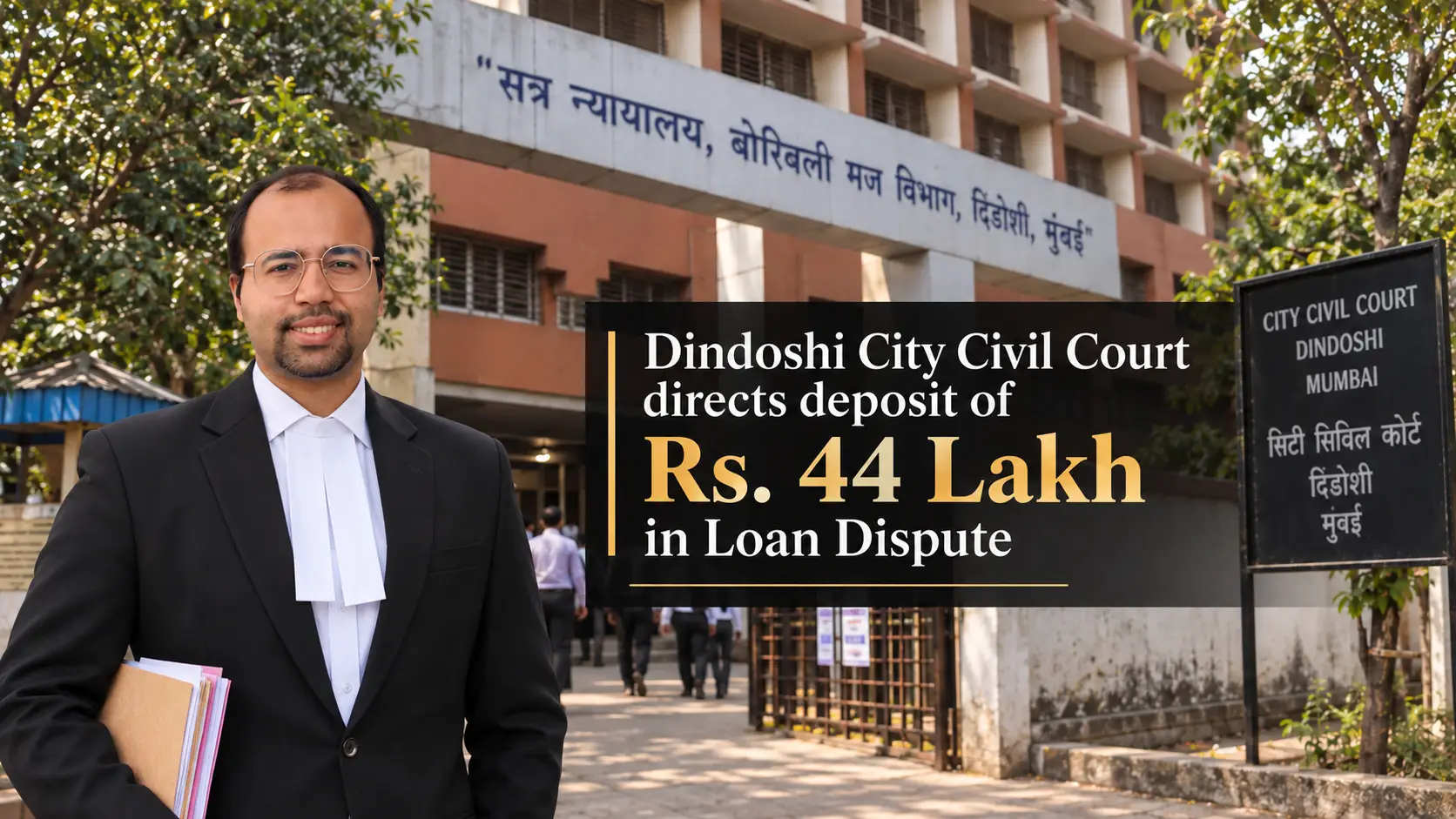

The Mumbai City Civil Court at Dindoshi directed a prominent Mumbai restaurateur to deposit Rs. 44,46,333/- (Rupees Forty Four Lakhs Forty Six Thousand Three Hundred and Thirty Three Only) towards the principal amount pending the final hearing and decision of a Commercial Summary Suit. The order was passed in a Summons for Judgment Application filed in a Commercial Summary Suit seeking recovery of an amount of Rs. 78,41,684/- (Rupees Seventy Eight Lakhs Forty One Thousand Six Hundred and Eight Four) from the Defendant Debtor. Advocate Aditya Pratap represented the Plaintiff creditor who had lent a sum of Rs. 55 lakhs to the defendant debtor, ostensibly for the latter’s business purposes.
The case was heard by the Ad Hoc Judge, City Civil Court,Borivali Division at Dindoshi Mumbai. During the arguments the Defendant Debtor admitted the fact that he had borrowed Rs. 55 lakhs from the plaintiff creditor. He further admitted that the principal amount of Rs. 44,46,333/- was outstanding while a sum of Rs. 10,53,667/- had been repaid to the plaintiff. However the defendant denied any liability to pay interest, claiming that the Plaintiff Creditor had lent him a ‘friendly loan’ without any liability to pay interest thereon.
Upon hearing the parties, the learned judge concluded that since the defendant debtor had admitted to the fact that Rs. 44.46 lakhs was outstanding, appropriate orders could be passed on the basis of his admission directing him to deposit the said sum with the court registry. Once this amount was deposited, the defendant debtor would be granted conditional leave to defend the suit as he had raised a dispute regarding his liability to pay interest.
On the issue of interest, the Court granted conditional leave to defend the suit subject to the Defendant Debtor depositing the admitted principal amount of Rs. 44.46 lakhs with the court registry, thereby securing the amount in dispute and providing the Plaintiff with a reasonable sense of security regarding the amount. The court held that since the defendant had admitted his liability to repay the principal amount, no triable issues arose on this point. However, since the defendant debtor disputed his liability to pay interest, the same would become a triable issue requiring adjudication. Hence conditional leave could be granted to the defendant debtor to defend the suit subject to him depositing the outstanding principal amount with the court registry. This would primarily serve protect the interests of the plaintiff while giving the defendant limited freedom to defend himself against the demands for payment of interest.
Relevant Facts of the Case
Presenting his client’s case before the Court, Advocate Aditya Pratap submitted that his client was an Indian citizen residing abroad and working as a salaried corporate professional with a reputed multinational company. He submitted that his client had a respectable professional background and was employed in a responsible position with the said multinational organisation.
Advocate Pratap submitted that the defendant businessman, who claimed to be in the restaurant and hospitality industry, approached him through a finance broker. The defendant requested the Plaintiff to advance a loan of Rs. 55,00,000/- (Rupees Fifty Five Lakhs Only) promising to pay interest at the rate of 12 percent per annum on the lent amount. The defendant businessman represented and warranted that the loan amount would be utilized for his restaurant business.
Advocate Aditya Pratap further submitted that his client agreed to the defendant’s proposal and advanced him a sum of Rs. 55 lakhs through two cheques of Rs. 25 lakhs and Rs. 30 lakhs each in 2017 and 2018 respectively. The defendant businessman issued two bills of exchange for the same amounts and also additionally issued cheques as security for the repayment of the said amount.
Pursuant to lending the money, the plaintiff received periodic interest payments from the defendant for some time. However from October 2019 the defendant debtor suddenly defaulted on his interest payments. When the plaintiff approached the defendant seeking recovery of his money, the defendant avoided responding to his calls. He also began making lame excuses to avoid repayment.
Dishonour of Bills of Exchange followed by Cheque Bounce – Commercial Summary Suit filed seeking recovery of the Loan Amount:
Aggrieved by the severity of the loan default committed by the defendant, the plaintiff proceeded to present the two bills of exchange to the defendant for payment. The presentment was done in accordance with Section 61 of the Negotiable Instruments Act of 1881. However the defendant did not pay the amount despite the two bills of exchange being present, dishonouring them in the process. This created a cause of action for filing a Commercial Summary Suit under Order 37 of the Code of Civil Procedure, 1908 read with the Commercial Courts Act of 2015.
Aggrieved by the dishonour of the two bills of exchange, the Plaintiff also proceeded to deposit the security cheques. They too were dishonoured. As a consequence, the plaintiff creditor invoked the concurrent remedy available to him under Section 138 of the Negotiable Instruments Act of 1881, resulting in a separate criminal case that proceeded independently.
Contentions of the Defendant:
Pursuant to being served with the summons for judgment, the defendant filed his application seeking leave to defend. He commenced his arguments by attempting to raise a preliminary objection challenging the maintainability of the commercial summary suit. He claimed that the commercial summary suit filed by the plaintiff was not maintainable under Order 37 of the Code of Civil Procedure, 1908.
The defendant debtor further objected to the suit claiming that it was not filed on the basis of any agreement. He further claimed that he had only obtained a ‘friendly’ loan from the plaintiff and was under no obligation to pay any form of interest on the said loan amount. The defendant further sought to attribute his inability to repay to the COVID-19 Pandemic which, he claimed, had caused him acute financial hardship.
Regarding interest, the defendant debtor denied having any liability to pay any interest on the loan advanced to him by the plaintiff creditor. He claimed that there was no written agreement between him and the plaintiff. The defendant further claimed that the plaintiff had given him a ‘friendly’ loan on which no interest would be payable. All repayments which the defendant purportedly made were towards the principal and not interest.
Rejoinder arguments by Advocate Aditya Pratap:
Upon the completion of the defendant’s arguments, Advocate Aditya Pratap commenced his submissions in rejoinder. He took the court in detail through the specifics of the pleadings made by the defendant in his application seeking leave to defend the suit. Advocate Pratap pointed out that the defendant had admitted to borrowing a sum of Rs. 55 lakhs from the plaintiff. The defendant had also admitted to having repaid an amount of Rs. 10,53,667/- (Rupees Ten Lakhs Fifty Three Thousand Six Hundred and Sixty Seven Only) towards the principal, leaving a total sum of Rs. 44,46,333/- (Rupees Forty Four Lakhs Forty Six Thousand Three Hundred and Thirty Three Only) outstanding towards the principal.
Advocate Aditya Pratap said that since the defendant had admitted to borrowing the sum of Rs. 55 lakhs, a fit case was made out for passing of orders under Order 12 Rule 6 of the Code of Civil Procedure, 1908. The defendant’s admission could be construed against him and orders could be passed directing the defendant to deposit the admitted amount with the court registry till the suit got decided. This would also protect the interests of the plaintiff as the principal amount could be secured while the court could decide the other contested issues raised in the suit in due course.
Advocate Aditya Pratap further submitted that given the fact that his client had suffered greatly, it was imperative that urgent orders be passed on the basis of the admissions made by the defendant. Since the defendant had admitted owing a sum of Rs. 44,46,333/- to the plaintiff, the said amount should be deposited with the court at the earliest to secure it. This way, even if adjudication of the other contested issue of interest took time, the principal amount could continue to accrue interest in a safe and secure bank deposit.
Observations, Reasoning and Findings of the Hon’ble Court:
Having heard both sides, the court began its observations by dwelling upon the preliminary issue of maintainability of the suit which was raised by the defendant debtor. The court held that the suit was filed on the basis of dishonoured bills of exchange and cheque. It noted that Order 37 Rule 1(2) of the Code of Civil Procedure, 1908 permits the filing of summary suits on the basis of bills of exchange and cheques. Therefore the suit filed by the plaintiff creditor was held to be maintainable.
The court also proceeded to record several key admissions made by the defendant debtor. The learned judge observed that the defendant debtor had admitted to borrowing the loan amount of Rs. 55 lakhs from the plaintiff creditor. The court also held the defendant to have admitted to repaying a sum of Rs. 10,53,667/- (Rupees Ten Lakh, Fifty Three Thousand Six Hundred and Sixty Seven) only towards the plaintiff. The court also noted the fact that the defendant debtor had admitted owing Rs. 44,46,333/- to the plaintiff creditor as on the date of hearing of the summary suit.
Thus, whether the defendant debtor had paid the sum of Rs. 10,53,667/- towards the principal amount or interest was a triable issue which had to be adjudicated in the manner provided by law. The court would have to determine whether the loan advanced by the plaintiff to the defendant was a friend loan devoid of interest or a business/commercial loan chargeable with interest.
Final Order:
The Court granted the defendant debtor conditional leave to defend the suit subject to the condition that the latter would deposit the outstanding principal sum of Rs. 44,46,333/- with the registry of the court. This sum, once deposited, was to be invested by the registrar (civil) with any nationalized bank for an initial period of one year. He was to seek further directions from the court as and when the suit came up for hearing.
The court further directed that only after the defendant had deposited the said amount of Rs. 44.46 lakhs that he would be permitted to file a written statement in response to the summary suit. If he failed to do so, the plaintiff would be at liberty to take appropriate steps as permitted to him under the law. It also ordered the conversion of the commercial summary suit into a regular civil suit once the mandated amount had been deposited by the defendant.